
Do Radiator Covers Reduce Heat Output? The Honest Answer for Specifiers
Do Radiator Covers Reduce Heat Output? The Honest Answer for Specifiers
Radiator covers can change heat output by altering convection and radiant heat transfer. The effect depends on the radiator, ventilation openings, clearances and heating-system conditions; there is no single reduction percentage that applies to every installation.
The key point: design matters more than the cover itself
A radiator cover should never be treated as a simple box around a heat source. Ventilation layout, clearance, material, grille position, radiator size, pipework, windowsills, TRVs and room use all affect the final result.
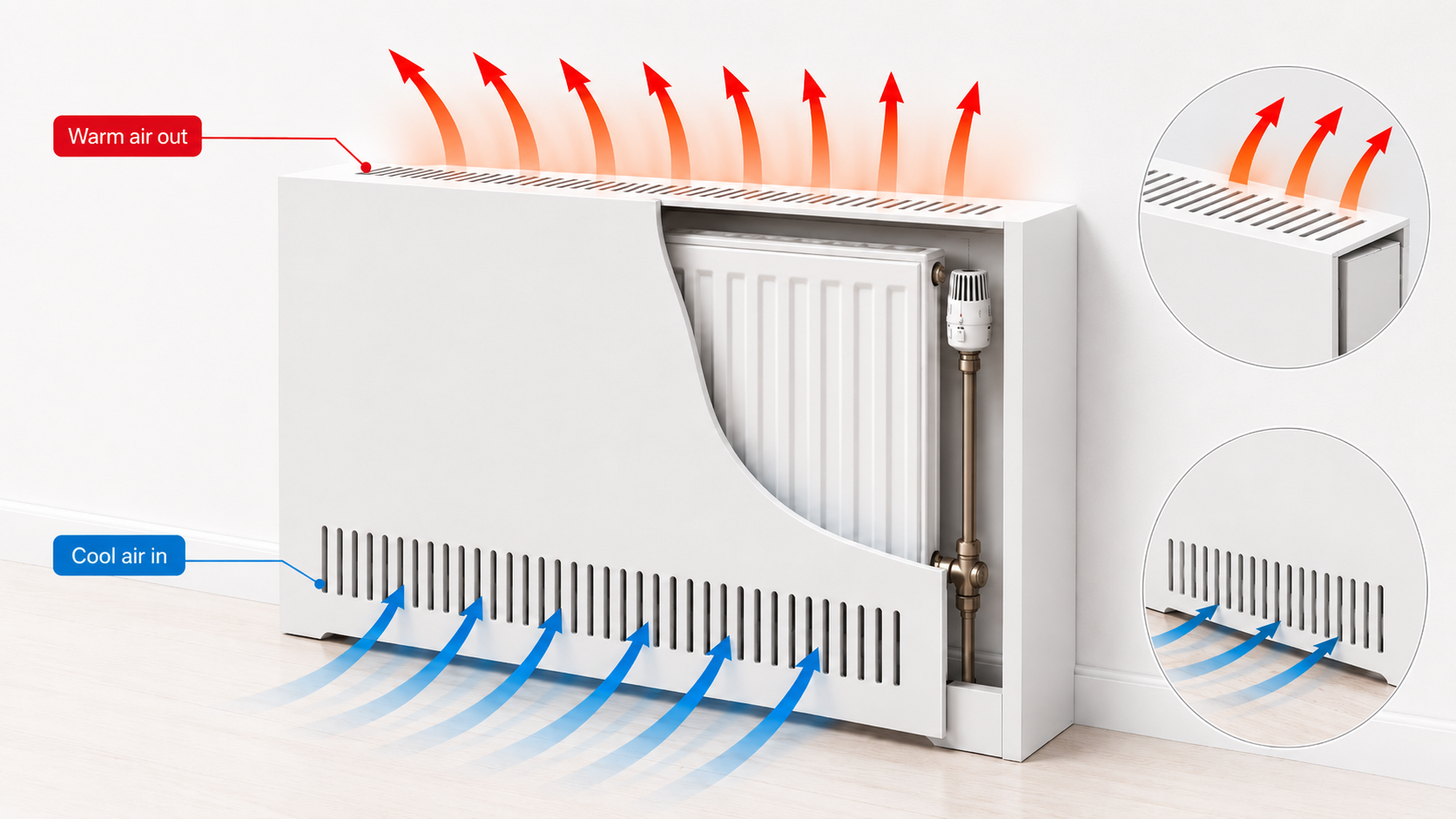
Poorly designed covers can restrict airflow. Properly specified covers are designed to allow warm air to move through the casing while helping to reduce direct contact with hot surfaces.
Why radiator covers can affect heat output
Radiators heat a room mainly through a combination of convection and radiant heat. When a cover is installed, it changes the way air moves around the radiator and how much direct radiant heat enters the room.
This is why airflow is so important. A cover with poor ventilation, limited clearance or blocked openings can trap heat inside the casing. A better-designed cover allows cooler air to enter, warm air to rise, and heat to circulate into the room more effectively.
Simple rule: radiator covers should be designed around airflow, access and the room environment — not just appearance.
What makes a radiator cover perform better?
The best-performing radiator cover is usually the one that has been properly surveyed and designed around the actual site conditions.
- Clear ventilation paths: air needs to enter and exit the cover efficiently.
- Suitable top and front grille design: grille position affects how heat leaves the casing.
- Correct clearances: tight covers can restrict airflow and create fitting issues.
- TRV and valve access: controls must remain usable where required.
- Awkward site details: windowsills, skirting, pipework and alcoves can all affect performance.
- Correct material and finish: the cover must be robust enough for the environment.
Where heat-output concerns are most important
Heat output should always be considered, but it becomes especially important in buildings where comfort, safety and maintenance all overlap.
Classrooms need safe heating without making the room uncomfortable or difficult to manage.
What to consider
Classroom layout, pupil safety, windowsills, furniture positions, TRV access and durability.
Residents may need protection from hot surfaces while still requiring warm, comfortable spaces.
What to consider
Bedrooms, lounges, circulation routes, cleaning access, resident vulnerability and maintenance needs.
Patient safety, infection control, maintenance access and room comfort all need to work together.
What to consider
Wards, waiting areas, treatment rooms, exposed pipework, cleaning routines and service access.
Common mistakes that reduce performance
Heat-output problems are often caused by specification or survey issues rather than the idea of a radiator cover itself.
- Too little clearance above or around the radiator.
- Blocked ventilation caused by furniture, storage or poor grille positioning.
- Ignoring windowsills that sit very close to the radiator.
- Not allowing for TRVs or valve access.
- Using a generic cover where the site needs a bespoke casing.
- Working from drawings only without checking real site conditions.
Best practice: where room heating performance matters, survey the radiator, pipework, controls, sill position and surrounding layout before manufacture.
Why survey-led design matters
Every building is different. A radiator that looks straightforward on a drawing may have a windowsill close above it, pipework entering from an unusual position, a TRV that needs regular access, or furniture nearby that affects airflow.
Survey-led design helps avoid these issues before manufacture. It allows the cover to be designed around the actual radiator position, available clearance, controls, wall condition and the way the room is used.
Coverad approach: we check radiator dimensions, clearances, sill heights, valves, pipework and fixing conditions so the final cover is practical for the building, not just made to a rough size.
Radiator covers and LST requirements
In vulnerable-user environments, heat output is only one part of the specification. The cover may also need to help manage contact risk, support low surface temperature intent, and reduce the chance of users touching hot radiators or exposed pipework.
This is particularly relevant in hospitals, care homes, nurseries, SEN schools and other public buildings where users may be young, elderly, unwell, disabled, or less able to move away from a hot surface.
In these settings, the question should not simply be “will a cover affect heat output?” A better question is:
Can the radiator cover be designed to balance safety, airflow, access, cleaning and long-term maintenance for this specific environment?
Which Coverad range should you consider?
The right option depends on the environment, maintenance requirements and risk profile.
- Standard Steel — robust covers for schools, public buildings and general commercial environments.
- Eazi-Access — useful where TRVs, valves and routine servicing need to remain accessible.
- Anti-Ligature — for mental health and secure environments requiring risk-conscious detailing.
- Anti-Ligature Secure+ — for higher-risk secure environments requiring controlled access and robust secure intent.
Suggested specification wording
Radiator covers: Supply and install bespoke radiator covers designed to allow suitable airflow, reduce contact risk and provide access to TRVs/valves where required. Manufacturer to carry out a free site survey to confirm radiator dimensions, clearances, pipework, fixing conditions, sill positions and access requirements before manufacture. Covers to be manufactured to suit each location, recorded as H × W × D in mm, and finished in powder coat to RAL ___.
The honest answer
Yes, radiator covers can affect heat output if they are poorly designed, badly ventilated or fitted too tightly around the radiator.
But that does not mean radiator covers should be avoided. In many schools, hospitals, care homes and public buildings, they provide an important balance between safety, appearance, protection, access and practicality.
The key is to specify the cover properly, survey the site accurately, and design the casing around the building rather than forcing a standard solution into an awkward space.
Concerned about heat output, access or airflow?
Coverad can survey your radiators, check clearances and recommend the most practical cover solution for your building.