
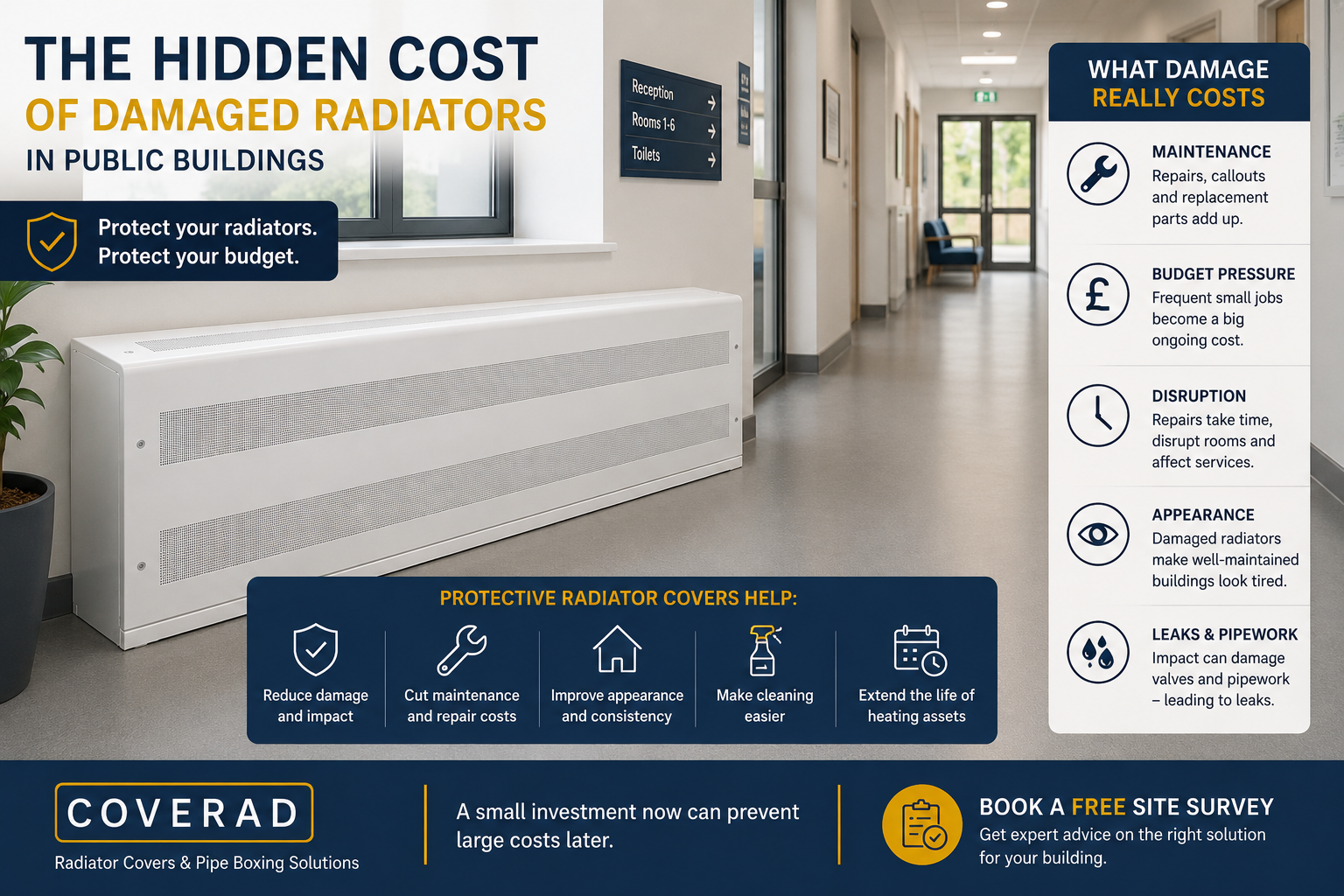
The Hidden Cost of Damaged Radiators in Public Buildings
The Hidden Cost of Damaged Radiators in Public Buildings
A damaged radiator might look like a small maintenance issue, but in busy public buildings it can quickly become more than a dented panel or loose valve.
In offices, hospitals, care homes, schools, universities, council buildings, leisure centres and other high-use environments, exposed radiators are often vulnerable to impact, misuse, cleaning equipment, furniture, trolleys and general day-to-day wear. Over time, those small knocks can lead to bigger costs.
The key point: radiator damage is rarely just cosmetic
A marked or dented radiator can make a room look tired, but the real cost often sits behind the surface. Damage can affect valves, pipework, brackets, paint finishes, cleaning routines, service calls and, in some cases, the usability of the space.
Protective radiator covers help reduce direct impact, protect heating equipment and give facilities teams a cleaner, more consistent finish to maintain.
Why exposed radiators get damaged
Radiators are often placed exactly where buildings are busiest: under windows, beside doors, along corridors, near beds, behind desks, in waiting rooms, next to seating, or close to cleaning and service routes.
In a quiet domestic room, that may not be a problem. In a public building, the radiator becomes part of the daily traffic route.
- Trolleys and equipment can knock radiators, valves and exposed pipework.
- Furniture movement can dent panels or damage paintwork.
- Cleaning equipment can repeatedly hit lower sections and pipework.
- Bags, chairs and storage can block, scrape or lean against radiators.
- High footfall areas increase the chance of accidental damage.
- Poor room layouts can leave radiators exposed to everyday contact.
Practical issue: radiators are heating equipment, but they often end up acting like unprotected wall furniture in some of the hardest-working areas of a building.
The costs people often miss
The obvious cost is the repair itself. The less obvious cost is the disruption around it: reporting the issue, arranging access, sending maintenance staff, ordering parts, touching up paint, dealing with leaks, moving furniture, or taking a room out of use.
In larger estates, these small jobs multiply. One damaged radiator may not seem like much, but repeated callouts across multiple buildings, rooms or floors can become a genuine facilities-management burden.
Small repairs, valve issues, paint damage and repeated callouts slowly consume time and budget.
Why it matters
The real cost is often labour, disruption and repeat attendance, not just the replacement part.
Dented, chipped or marked radiators can make otherwise well-maintained spaces look neglected.
Why it matters
Public-facing areas, waiting rooms and shared spaces all influence how the building is perceived.
Repairs may require access arrangements, downtime, heating isolation or temporary room changes.
Why it matters
The disruption around the repair can be more frustrating than the damage itself.
Damage to valves and pipework can be more serious
A dented radiator panel is one thing. Damage to valves, TRVs, pipework or connections can be more serious because it may affect heating control, create leaks, or require more urgent attention.
Exposed pipework at low level is especially vulnerable in corridors, bedrooms, bathrooms, changing areas, waiting spaces and service routes. Once pipework or valves are damaged, the issue can quickly move from cosmetic to operational.
Often overlooked: protecting the radiator is only part of the job. Pipework, valves and access points should also be considered when assessing damage risk.
Cleaning and hygiene issues
Exposed radiators can be awkward to clean around, especially where there are fins, pipework, brackets, inaccessible gaps or damaged paint. In busy buildings, these areas can become dust traps or difficult cleaning points.
A well-designed radiator cover can provide a cleaner external surface and a more consistent finish, while access-focused designs can help maintenance and cleaning teams reach key areas when required.
- Cleaner appearance: covers can hide damaged or dated radiator surfaces.
- More consistent finish: useful across corridors, bedrooms, classrooms and public areas.
- Access planning: covers can be specified with maintenance and cleaning access in mind.
- Reduced exposed detail: fewer awkward surfaces visible in everyday use.
Why protective steel covers make sense
A protective steel radiator cover creates a robust barrier between the radiator and the building environment. Rather than leaving heating equipment exposed to daily knocks, the cover becomes the protective outer layer.
This is particularly useful where buildings have high footfall, repeated room turnover, vulnerable users, public access, cleaning routines or regular movement of furniture and equipment.
Helps protect radiators, valves and pipework from everyday knocks and accidental impact.
Best suited to
Corridors, waiting areas, bedrooms, classrooms, communal rooms and high-use public spaces.
Creates a uniform appearance across multiple rooms, floors or buildings.
Best suited to
Refurbishment projects, estates upgrades and public-facing environments.
Access can be designed around TRVs, valves, cleaning and maintenance needs.
Best suited to
Sites where facilities teams need practical servicing without unnecessary disruption.
Lifecycle cost: the real reason to specify covers
The cheapest approach is not always the lowest-cost approach over time. Leaving radiators exposed can seem economical at installation stage, but repeated damage, touch-ups, callouts and complaints can erode that saving.
A properly specified cover can reduce avoidable damage, improve appearance, make cleaning easier, support access and help standardise the estate. For many facilities teams, that is where the long-term value sits.
Facilities question: how much time and budget is currently being spent reacting to radiator damage, rather than preventing it?
Common mistakes when trying to protect radiators
Radiator protection only works properly when the cover is designed around the building, not guessed from a rough size or treated as a generic box.
- Using timber boxing without considering durability, cleaning, access or ventilation.
- Forgetting TRV access and making future temperature control awkward.
- Ignoring exposed pipework and only covering the radiator panel.
- Not checking furniture positions or traffic routes around the radiator.
- Working from drawings only without checking site conditions.
- Choosing a finish that is not resilient enough for the environment.
Best practice: survey the area, understand the risk, confirm access requirements and specify a cover that fits the way the building is actually used.
Which Coverad range should you consider?
The right product depends on the building, users, access needs and level of protection required.
- Standard Steel — robust protection for general public buildings, corridors, offices and commercial environments.
- Eazi-Access — useful where TRVs, valves and routine servicing need to remain easily accessible.
- Anti-Ligature — for mental health, secure and higher-risk environments requiring risk-conscious detailing.
- Anti-Ligature Secure+ — for more secure environments requiring controlled access and robust secure intent.
Suggested specification wording
Protective radiator covers: Supply and install bespoke steel radiator covers to protect existing radiators, valves and exposed pipework from impact damage and day-to-day wear. Manufacturer to carry out a free site survey to confirm radiator dimensions, pipework, clearances, valve access, fixing conditions and surrounding obstructions before manufacture. Covers to allow suitable airflow, provide access to TRVs/valves where required, and be powder coated to RAL ___ with grille style and access requirements agreed for each location.
The practical answer
Damaged radiators can cost more than they first appear. The visible dent or chipped paint is only part of the issue. The hidden cost is in maintenance time, disruption, repeated callouts, poor appearance, cleaning challenges and potential damage to valves or pipework.
Protective radiator covers help facilities teams move from reactive repair to planned protection. They can make spaces look cleaner, protect heating equipment and support long-term maintenance when properly specified.
For busy public buildings, that can make radiator covers a sensible investment rather than just a finishing detail.
Want to reduce radiator damage across your building?
Coverad can survey your site, assess radiator and pipework exposure, and recommend a protective cover solution suited to the way your building is used.