
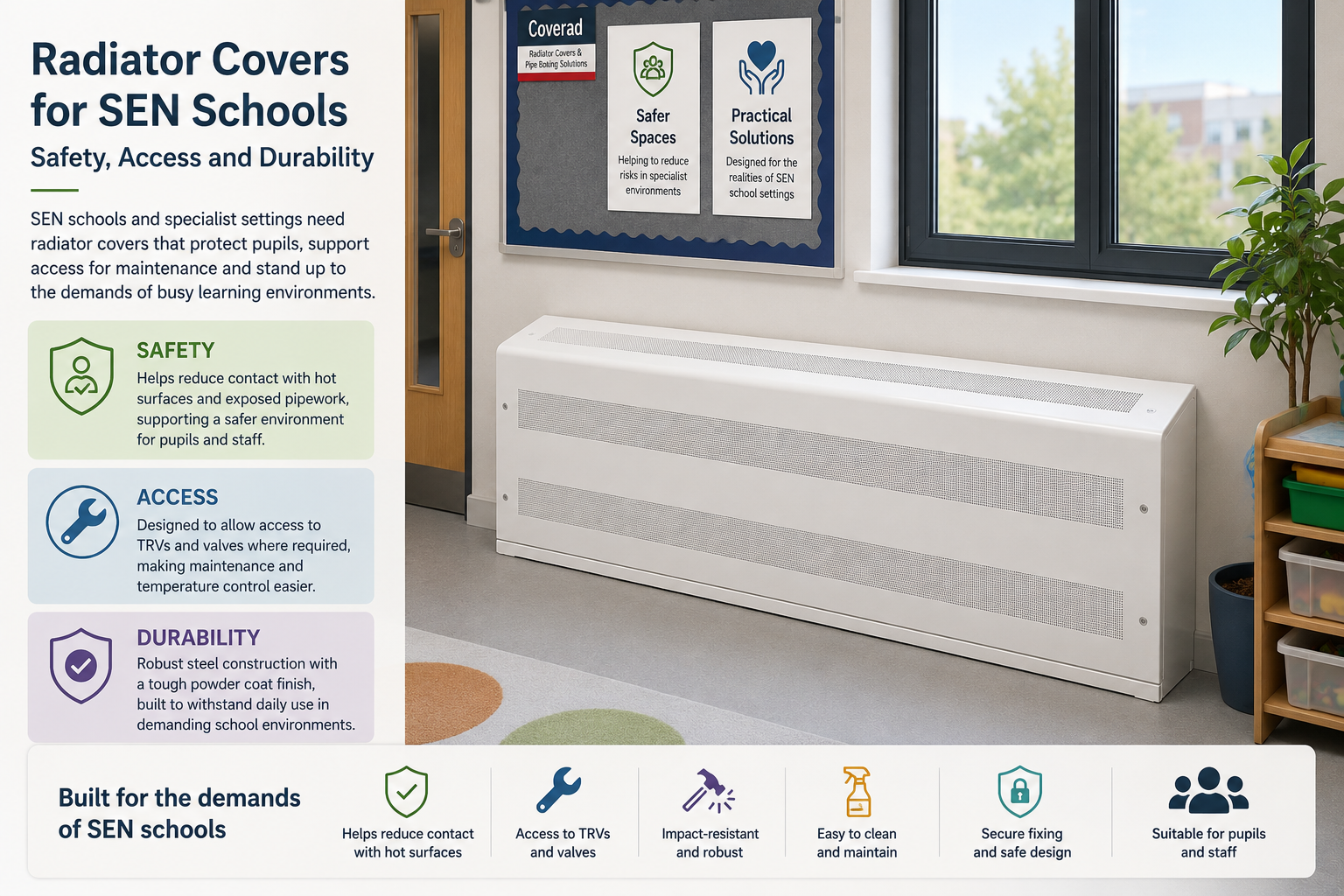
Radiator Covers for SEN Schools: Safety, Access and Durability
Radiator Covers for SEN Schools: Safety, Access and Durability
SEN schools and specialist education settings often need more than a standard radiator cover. The right solution must balance pupil safety, surface-temperature risk, impact resistance, maintenance access, cleaning and day-to-day practicality.
For specifiers, school estates teams and contractors, the challenge is to choose radiator covers that protect pupils and staff without creating problems for heating performance, access or long-term maintenance.
The key point: SEN environments need practical, risk-led design
In SEN settings, pupils may have different mobility, sensory, behavioural or awareness needs. Some may be more likely to touch hot surfaces, lean against radiators, fall near heating equipment, or interact with fixtures in unexpected ways.
That is why radiator covers for SEN schools should be considered as part of the wider risk assessment, not treated as a simple finishing item.
Why radiator covers matter in SEN schools
Radiators and exposed pipework can sit close to desks, soft play areas, sensory rooms, corridors, toilets, changing areas and circulation routes. In a busy school environment, these locations can create contact risks, maintenance challenges and durability issues.
A well-specified radiator cover can help reduce direct contact with hot surfaces, improve the appearance of the space, and protect heating equipment from knocks and everyday school use.
Important: every SEN setting is different. The correct cover design should be based on the pupils using the space, the location of the radiator, access requirements, surface-temperature considerations and the way the room is used.
What SEN schools should consider
A good radiator cover specification should look beyond size and finish. In SEN environments, the small details often matter most.
Reducing contact with hot radiators, sharp edges, exposed pipework and vulnerable heating components.
What to consider
Low surface temperature intent, rounded detailing, secure fixing, grille style and pupil interaction with the space.
TRVs, valves and service points may still need to be reached without disrupting the school day.
What to consider
Eazi-Access options, valve positions, lockable access, cleaning routines and future maintenance needs.
School fixtures need to withstand regular knocks, cleaning, daily use and occasional misuse.
What to consider
Steel thickness, powder coat finish, fixing method, location risk and whether a more robust specification is needed.
Low surface temperature and hot-surface risk
In spaces used by younger pupils or pupils with additional needs, surface-temperature risk should be considered carefully. This is particularly important where pupils may have reduced awareness of danger, reduced mobility, sensory needs, or a greater chance of coming into contact with a radiator.
Radiator covers can help manage contact risk by creating a protective casing between the pupil and the radiator or pipework. The cover design should still allow heat to circulate properly and should be suited to the room layout.
Best practice: where hot-surface risk is a concern, check both the radiator and any exposed pipework. Pipework is often overlooked but can present similar contact risks.
Access for maintenance and temperature control
In a school, maintenance access needs to be practical. Staff may need to adjust TRVs, isolate valves, bleed radiators, clean around covers or inspect heating components without major disruption.
This is where access-focused radiator covers can make a real difference. A cover that looks safe on day one but makes maintenance difficult can become a frustration for the site team later.
- TRV access: confirm whether the valve needs regular adjustment.
- Service access: ensure maintenance teams can reach key components when needed.
- Cleaning access: consider dust traps, wipe-clean surfaces and hygiene routines.
- Locking/security: decide whether access should be controlled by staff only.
Coverad option: Eazi-Access radiator covers are useful where routine servicing and valve access need to remain practical.
Durability in busy learning environments
SEN schools can place heavy demands on fixtures and fittings. Radiator covers may be exposed to trolleys, furniture, bags, cleaning equipment, pupils moving through corridors, and general school wear and tear.
A robust steel cover with a resilient powder coat finish can help protect the radiator while providing a cleaner, more consistent appearance across classrooms and shared spaces.
- Material: steel covers provide a robust protective casing.
- Finish: textured powder coating can help withstand everyday school use.
- Fixing: secure installation matters, especially in high-use spaces.
- Grille design: ventilation should support airflow while suiting the risk profile of the space.
Common specification mistakes
Problems usually arise when covers are specified too generically or when the room has not been properly surveyed.
- Only measuring the radiator and ignoring pipework, skirting, sills and valves.
- Forgetting access to TRVs, valves or maintenance points.
- Choosing a standard cover where a bespoke solution is needed.
- Ignoring airflow and creating a casing that restricts heat movement.
- Overlooking exposed pipework, especially in toilets, corridors and teaching spaces.
- Not considering pupil behaviour or the specific needs of the room.
Survey-led design reduces risk: accurate survey information helps avoid rework, improves fit, and ensures the final cover is practical for the school environment.
Which Coverad range should you consider?
The right product depends on the school, the room use and the level of risk identified.
- Standard Steel — robust general-purpose radiator covers for classrooms, corridors and shared school spaces.
- Eazi-Access — useful where TRVs, valves and maintenance access need to remain practical.
- Anti-Ligature — suitable for higher-risk environments where ligature reduction is part of the specification.
- Anti-Ligature Secure+ — for more secure environments requiring controlled access and robust secure detailing.
Suggested specification wording
SEN school radiator covers: Supply and install bespoke steel radiator covers designed to reduce contact with hot radiators and exposed pipework, provide suitable airflow, and allow access to TRVs/valves where required. Manufacturer to carry out a free site survey to confirm radiator dimensions, pipework, clearances, sill positions, fixing conditions and access requirements before manufacture. Covers to be finished in powder coat to RAL ___, with grille style, access and security requirements agreed for each location.
The practical answer
Radiator covers for SEN schools need to do several jobs at once. They should help manage contact risk, protect heating equipment, support airflow, allow maintenance access and withstand the realities of a busy school environment.
The best results come from treating the cover as part of the wider room design, not just an item fitted over a radiator. That means considering the pupils, staff, room use, access needs and site conditions before manufacture.
With the right survey and specification, radiator covers can provide a safer, cleaner and more durable heating solution for SEN schools and specialist education settings.
Need radiator covers for an SEN school or specialist education setting?
Coverad can survey your building, check clearances, review access requirements and recommend the most practical radiator cover solution for each space.