
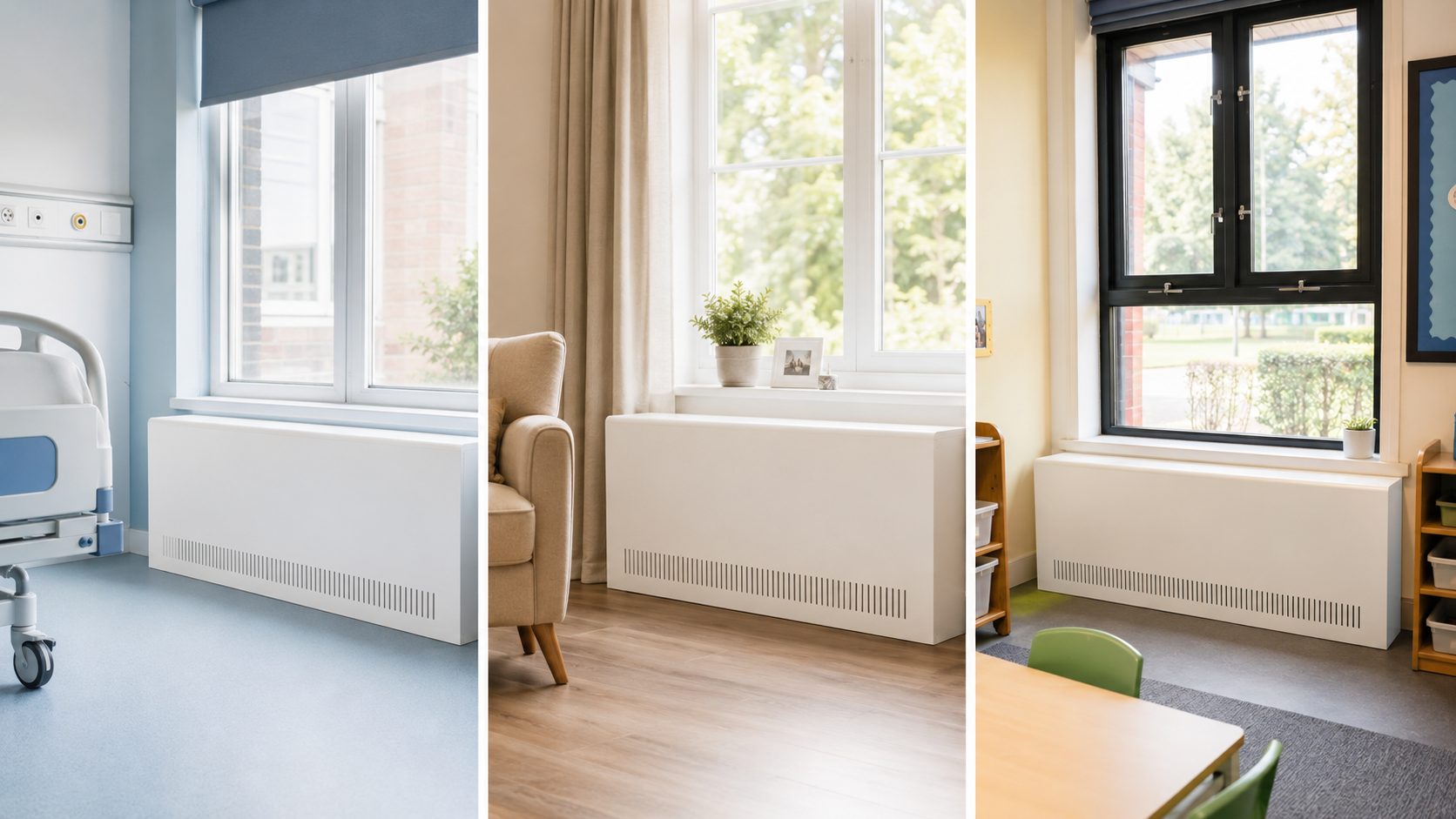
Low Surface Temperature Radiator Covers: UK Guidance for Hospitals, Care Homes and Schools
Low Surface Temperature Radiator Covers: UK Guidance for Hospitals, Care Homes and Schools
In hospitals, care homes, schools and other public buildings, radiator safety is not just about comfort. Where people are vulnerable, young, elderly, unwell, disabled, or less able to move away from a hot surface, exposed radiators and pipework can become a serious burn risk.
Low surface temperature radiator covers are designed to help reduce that risk by limiting direct contact with hot surfaces, while still allowing practical heat output, cleaning access and maintenance access where required.
The key point: 43°C is the benchmark to understand
In health and social care settings, HSE guidance says that where there is a risk of a vulnerable person sustaining a burn from a hot surface, the surface should not exceed 43°C when the system is running at maximum design output.
For schools, the Education (School Premises) Regulations 1999 specifically refer to a 43°C limit for radiators and exposed pipework that may be touched by pupils in special schools, nursery schools or teaching accommodation used by nursery classes.
What does “low surface temperature” mean?
“Low surface temperature” is generally used to describe heating products or protective casings designed so that accessible surfaces remain within a safer temperature range.
In plain English, the aim is to reduce the risk of someone being burned if they touch, lean against, fall against, or become trapped against a radiator or exposed pipework.
Important: This does not mean every radiator in every building automatically requires a cover. The right approach depends on risk assessment, who uses the space, where the radiator is positioned, and whether hot surfaces are accessible.
Why it matters in hospitals and care homes
In healthcare and adult social care environments, the people using the building may be elderly, unwell, sedated, confused, immobile, visually impaired, or unable to react quickly if they come into contact with a hot surface.
That makes exposed radiators and pipework a particular concern in bedrooms, bathrooms, en-suites, wards, corridors, assessment rooms and mental health settings.
A bespoke radiator cover can help manage contact risk while still allowing for practical cleaning, maintenance and access to TRVs or valves where required.
Why it matters in schools, nurseries and SEN environments
Schools bring a different type of risk. Younger children may touch surfaces out of curiosity, fall against radiators during play, or not understand the danger quickly enough.
In special schools, nurseries and nursery-class teaching spaces, assess accessible radiators and pipework carefully, taking account of pupils who may be less able to recognise or move away from hot surfaces.
In practice, schools also need to think about desks, play areas, circulation routes, windowsills, coat hooks, storage, pipework and long wall-to-wall runs where radiator positions may be close to everyday activity.
At-a-glance: where the risk usually sits
Patients may be unwell, immobile, confused, sedated or less able to react.
What to consider
Wards, bedrooms, en-suites, bathrooms, waiting areas, corridors and exposed pipework.
Residents may have reduced mobility, frailty, sensory impairment or fall risk.
What to consider
Bedrooms, bathrooms, lounges, communal areas, furniture positions and unsupervised spaces.
Children may touch hot surfaces or fall against radiators during normal use.
What to consider
Nursery spaces, SEN settings, classrooms, corridors, pipework and areas near play or learning activity.
Radiator covers vs replacing the radiator
In some projects, replacing radiators with purpose-made LST radiators may be the right answer. In many refurbishment projects, however, a bespoke radiator cover can be a more practical and cost-effective route.
Covers can allow existing radiators to remain in place while reducing contact with hot surfaces. They can also be designed around awkward site conditions such as close windowsills, skirting, pipework, TRVs, wall-to-wall runs and tight alcoves.
This is where a survey-led approach matters. Drawings rarely show every detail that affects whether a cover will fit cleanly and perform properly.
What specifiers should include
If radiator covers are being specified for a hospital, care home, school or other vulnerable-user environment, the tender notes should be clear about performance intent, access and site verification.
- Surface-temperature intent: refer to managing hot-surface contact risk in line with the relevant risk assessment.
- Survey requirement: manufacturer to survey and confirm final sizes before manufacture.
- Measurement format: sizes recorded as H × W × D in mm.
- Access: confirm whether TRVs, valves and bleeding points must remain accessible.
- Pipework: consider exposed pipework as well as the radiator itself.
- Cleaning: specify wipe-clean surfaces and reduced dust-trap detailing where relevant.
- Security: for mental health or secure settings, specify anti-ligature or Secure+ intent clearly.
Which Coverad range should you consider?
The right range depends on the environment, access requirements and risk profile.
- Standard Steel — robust general-purpose covers for schools, public buildings and commercial environments.
- Eazi-Access — useful where servicing access, TRVs and long-term maintenance matter.
- Anti-Ligature — for mental health and secure environments requiring risk-conscious detailing.
- Anti-Ligature Secure+ — for higher-risk secure settings where controlled access and robust secure intent are required.
Useful official guidance
For project teams reviewing hot-surface risk, these official sources are useful starting points:
- HSE: Scalding and burning
- HSE: Managing the risk from hot water and surfaces in health and social care
- Department for Education — current school premises guidance
Note: This article is general guidance only and is not legal advice. The duty holder or project team should carry out a suitable risk assessment and confirm the relevant requirements for the building and users.
Suggested tender wording
Radiator covers / hot-surface protection: Supply and install bespoke radiator covers to reduce contact risk with radiators and exposed heating pipework where identified by the project risk assessment. Manufacturer to carry out a free site survey to confirm final sizes, clearances, pipework, valves, fixing conditions and access requirements prior to manufacture. Covers to be manufactured to suit each location, recorded as H × W × D in mm, with suitable access to TRVs/valves where required. Finish: powder coated to RAL ___. Access, cleaning and security requirements to be confirmed for the specific environment.
Need help assessing radiator cover requirements?
If you manage a hospital, care home, school or refurbishment project and need to reduce hot-surface risk, Coverad can survey and recommend the most practical radiator cover approach.