
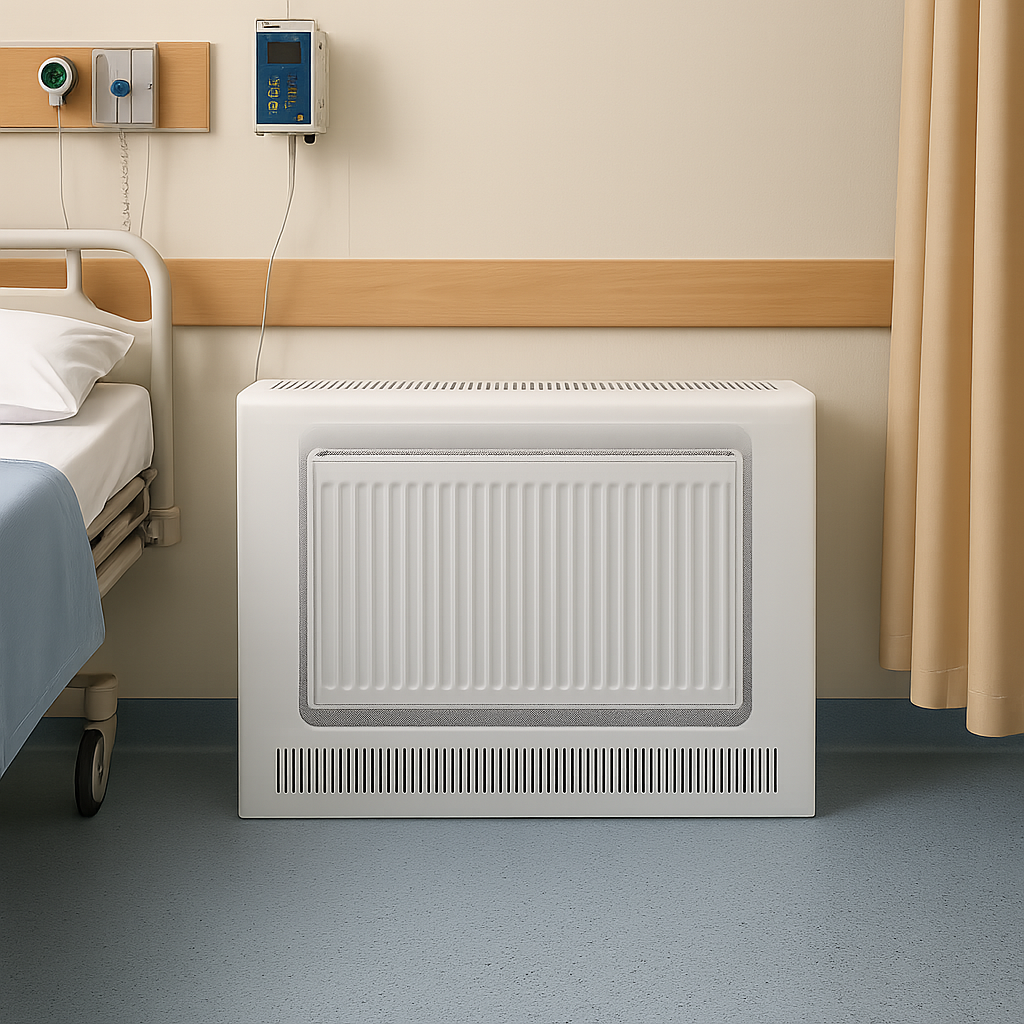
Standard Steel vs Eazi-Access vs Anti-Ligature vs Secure+: Which Should You Specify?
Standard Steel vs Eazi-Access vs Anti-Ligature vs Secure+: Which Should You Specify?
If you’re specifying radiator covers for a project, choosing the right range is usually about three things:
environment, maintenance access and tamper resistance.
This guide gives you a simple decision path — so you can specify confidently and avoid the common issues (blocked TRVs, awkward servicing,
and covers that aren’t robust enough for the space).
Specifiers & Estates Teams
Free manufacturer survey available
If maintenance access is frequent → lean towards Eazi-Access.
If security / tamper is critical → specify Anti-Ligature or Secure+.
For general robust applications → Standard Steel.
Manufacturer-led survey to confirm sizes, access needs and site constraints (free survey available).
Option 1: Standard Steel (general robust applications)
A strong all-round option for education, commercial and public buildings where you want a tidy, durable finish with long service life.
- Schools, offices, corridors, communal areas
- Refurb programmes needing consistent look/finish
- General environments where security risk is low
- You want robust construction and clean appearance
- You don’t need frequent access panels/hinging
- TRV access can be handled by sensible cut-outs/details
Option 2: Eazi-Access (when servicing needs to be quick)
Ideal for estates teams and maintenance-heavy sites where covers need to allow easier servicing access over the building’s life.
- Healthcare, care homes, large estates portfolios
- Sites with frequent TRV adjustment / bleeding / valve changes
- Areas where disruption must be minimised
- Access strategy matters as much as appearance
- You want less “fighting the cover” during maintenance
- You need practical long-term serviceability
Option 3: Anti-Ligature (secure environments)
For environments where risk reduction and tamper resistance are required. Your spec should state the intent clearly
(environment, access method, and tamper requirement).
- Mental health, secure wards, high-risk settings
- Areas where tamper resistance is required
- Projects with defined security intent
- You need risk-conscious detailing
- You want a solution designed for challenging environments
- Access is defined and controlled appropriately
Option 4: Anti-Ligature Secure+ (Eazi-Access Secure)
Where a higher-security approach is required, Secure+ provides a strong focus on robust construction and controlled access.
Specify it when you need a clearer “secure intent” rather than a generic anti-ligature reference.
- Higher-risk secure environments
- Settings needing controlled maintenance access
- Projects where substitutions must be avoided
- You need defined secure intent and robust detailing
- Authorised-only access is part of the requirement
- You want to reduce ambiguity at tender stage
Quick comparison (one-glance)
| Range | Best for | Key spec focus |
|---|---|---|
| Standard Steel | General robust installations | Durability + tidy appearance |
| Eazi-Access | Maintenance-heavy sites | Servicing access strategy |
| Anti-Ligature | Secure environments | Tamper resistance intent |
| Secure+ | Higher-risk secure environments | Controlled access + robust security intent |
access requirements and site constraints before manufacture.
What to put in your tender notes (copy/paste)
Manufacturer to carry out a free site survey to confirm final sizes, cut-outs and access requirements prior to manufacture.
Sizes recorded as H × W × D in mm. Finish: powder coated to RAL ___.
Fixings and access strategy to suit wall type, environment and maintenance needs.
Where secure environments apply, specify Anti-Ligature or Anti-Ligature Secure+ as required, including controlled access and tamper-resistant fixings.
FAQs
Do radiator covers reduce heat output?
A well-designed cover should allow practical airflow in and out. Performance is influenced by the air gaps and how closely the cover sits to the radiator.
As typical guidance, allow clearance intent such as 100mm ideal above (50mm minimum if needed), 100mm each side where practicable, and 50mm in front.
For tight sites or unusual constraints, a manufacturer-led survey is the safest way to confirm the best approach.
When should I specify Standard Steel vs Eazi-Access?
Use Standard Steel for general robust applications where you want a durable, tidy finish and don’t expect frequent servicing access.
Choose Eazi-Access when ongoing maintenance matters — for example where TRVs are adjusted often, bleeding is common, or estates teams
need quicker access with less disruption. Links: Standard Steel · Eazi-Access.
What’s the difference between Anti-Ligature and Anti-Ligature Secure+?
Both are intended for secure environments where risk reduction and tamper resistance are required. Secure+ should be specified where a higher-security
approach and clearer “secure intent” is needed, including controlled access requirements. If you want to reduce ambiguity (and avoid substitutions),
reference Secure+ explicitly. Link: Anti-Ligature Secure+.
How do I specify valve / TRV access properly?
State whether the TRV must remain adjustable without removing the cover. If access will be frequent, consider an access-first approach
(e.g., Eazi-Access) so maintenance teams aren’t forced to remove covers for simple adjustments.
Always note unusual pipe routes, boxing, skirting and obstructions — and ideally have the manufacturer confirm on survey.
Who should take responsibility for measurements?
Best practice is a manufacturer-led survey so final sizes, cut-outs and access requirements are confirmed before manufacture.
This reduces risk and avoids costly rework — especially on refurbishment programmes and healthcare/care environments.
What should I include in tender notes to avoid issues later?
Include: measurement format (H × W × D in mm), finish (RAL), wall type/fixing assumptions, whether TRVs must remain accessible,
the access method (removable/hinged/service access), and the security/tamper intent where relevant. Then require the manufacturer to survey and confirm
sizes prior to manufacture.
Want us to recommend the right range for your project?
Send your schedule (or drawings) and we’ll advise the best option — and we can carry out a
free site survey to confirm sizes and constraints before manufacture.